
About Us
On the evening of March 16, 1981, an idea became reality. Neil Aldridge gathered with Budgie Atkinson and Larry Argo at David’s Lounge to share his vision for a new gay Mardi Gras organization. While similar groups had existed in the past, none had endured. By the end of the evening, bylaws had been discussed, leadership positions established, membership dues determined, and fundraising plans proposed. A unique carnival organization dedicated to celebrating Mobile’s Mardi Gras tradition was born.
Since hosting our first ball in January 1982, the Order of Osiris has become renowned for its richly decorated tables and elaborate costumes. Associate and honorary members design and decorate the tables, while active members create lavish costumes and tables that complement their chosen themes. These displays are far more than simple centerpieces—many require as much creativity, effort, and expense as the costumes themselves.
Today, with approximately 60 active and associate members, the Annual Ball welcomes thousands of guests each year. Attendees are greeted by the organization’s signature tableau, a spectacular production lasting between 90 minutes and two hours. Featuring elaborate costumes, themed floats, intricately designed tables, music, lighting, and theatrical props, the tableau has become the hallmark of the Order of Osiris and an experience unlike any other Mardi Gras ball.
The Order of Osiris fulfilled a long-held dream within Mobile’s gay community by creating an inclusive carnival organization that proudly represents its members during Mardi Gras. As we honor our history and traditions, we look forward to celebrating many more Annual Balls in the years to come.
The tradition continues with our motto: “Never too big, never too much!” — Neil Aldridge
Osiris Mythology - Our Three Emblems
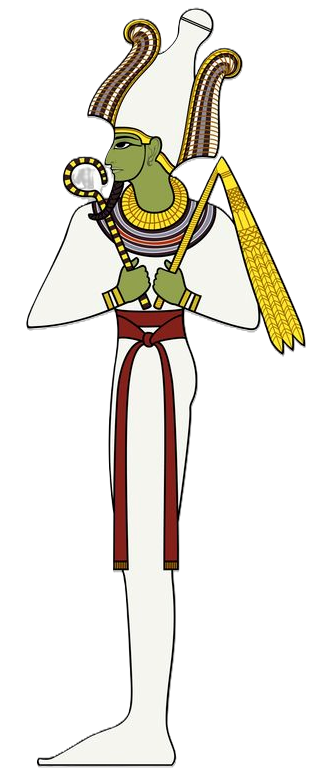
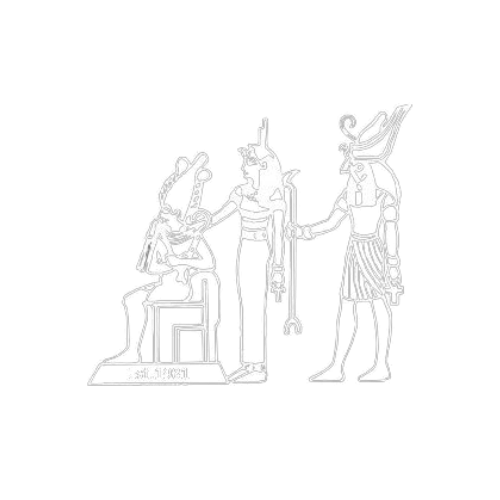
Also called Usir, Osiris was a major ancient Egyptian god. He likely began as a local god of Busiris in Lower Egypt and may have represented underworld fertility. By about 2400 BCE he had two clear roles: a god of fertility and the symbol of the dead, resurrected king. Egyptian kingship linked these roles: a dead king became Osiris, ruler of the underworld, while his living son became Horus, a sky god. Thus Osiris and Horus were father and son. Isis was the king’s mother—mother of Horus and wife of Osiris. Seth was Osiris’s murderer and Horus’s enemy.
In the version told by the Greek writer Plutarch, Seth killed or drowned Osiris, cut his body into 14 pieces and scattered them across Egypt. Isis and her sister Nephthys recovered and buried all the pieces except the phallus, restoring Osiris so he could live on as underworld ruler and judge. Horus later defeated Seth, avenging Osiris and becoming king of Egypt.
Osiris ruled the dead and was also the source of life from the underworld, from new plant growth to the Nile’s annual flood. From about 2000 BCE, ordinary people—not just kings—were thought to become associated with Osiris at death. This did not mean literal resurrection (Osiris himself did not truly rise); rather it meant renewal of life in the afterlife and through one’s descendants on earth. As this idea spread, Osiris’s cult merged with many local fertility and underworld cults across Egypt.
Osiris
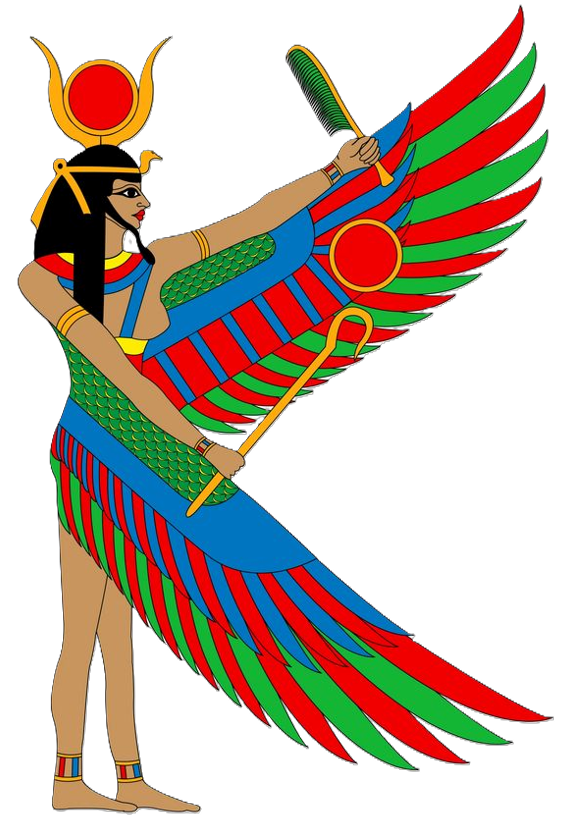
The Egyptian goddess of magic and life, Isis, was revered as the protector of mothers, women, and children. She was also widely worshipped as a goddess of healing. Her name, often translated as "Queen of the Throne," is represented by the throne-shaped emblem she wears upon her head. The hieroglyph associated with her name originally meant “she of flesh” or “mortal,” suggesting a possible connection to historical queens and early female deities.
According to ancient Egyptian belief, the annual flooding of the Nile River was caused by the tears Isis shed in mourning for her husband, Osiris. Although her exact origins remain uncertain, scholars believe her worship began in the Nile Delta region. Unlike many Egyptian gods and goddesses, Isis did not have a single centralized cult center. The earliest known references to her date back to Egypt’s Fifth Dynasty, appearing in some of the first literary inscriptions. Over time, her influence grew significantly, and her cult absorbed the attributes and worship practices of numerous other goddesses, making her one of the most important and widely venerated deities in the ancient Egyptian world.
Isis
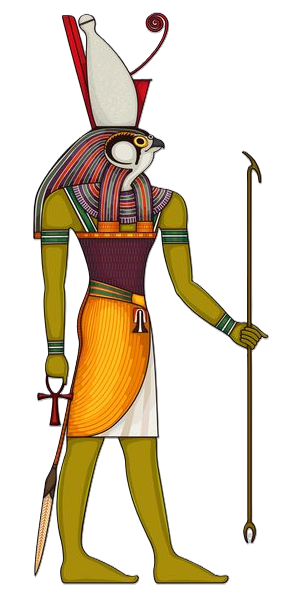
The ancient Egyptian god of the sky and the sun, Horus, is a complex deity whose name can refer to several related gods within Egyptian religion. The most prominent are Horus the Elder (Heru-ur) and Horus the Younger (Heru-pa-khart), along with a number of lesser deities associated with the Horus tradition. The earliest form of Horus is believed to have been a sky god, with his name meaning “the high one” or “the distant one.”
Horus was commonly depicted as a magnificent falcon with outstretched wings. Ancient Egyptians believed that his right eye represented the sun and his left eye represented the moon. Because Horus embodied the sky itself, the sun and moon were thought to travel across the heavens as he flew overhead in falcon form. This association earned him the title Harmerty, meaning “Horus of the Two Eyes.”
The difference in brightness between the sun and the moon was explained through a famous myth known as the Contendings of Horus and Set. This story symbolized the struggle for dominance between Upper and Lower Egypt around 3000 B.C. In the myth, Set and Horus fought for the right to rule Egypt. Although the conflict lasted for many years without a clear victor, the other gods ultimately judged in favor of Horus, granting him kingship over Egypt. As a result, Horus became a symbol of rightful rule, divine kingship, and the unification of the Egyptian kingdom.
Horus